
What You Measure Matters
The cattle industry talks a lot about data. But most of what is measured and taught does not translate to fertility, longevity, or profit. It looks good in a sale catalog. It fits a spreadsheet. But it falls apart in the pasture.
Meanwhile, fertility is in decline. Calf crops are shrinking. Inputs are rising. And producers are being told the problem is management.
We disagree.
The Data Says It All
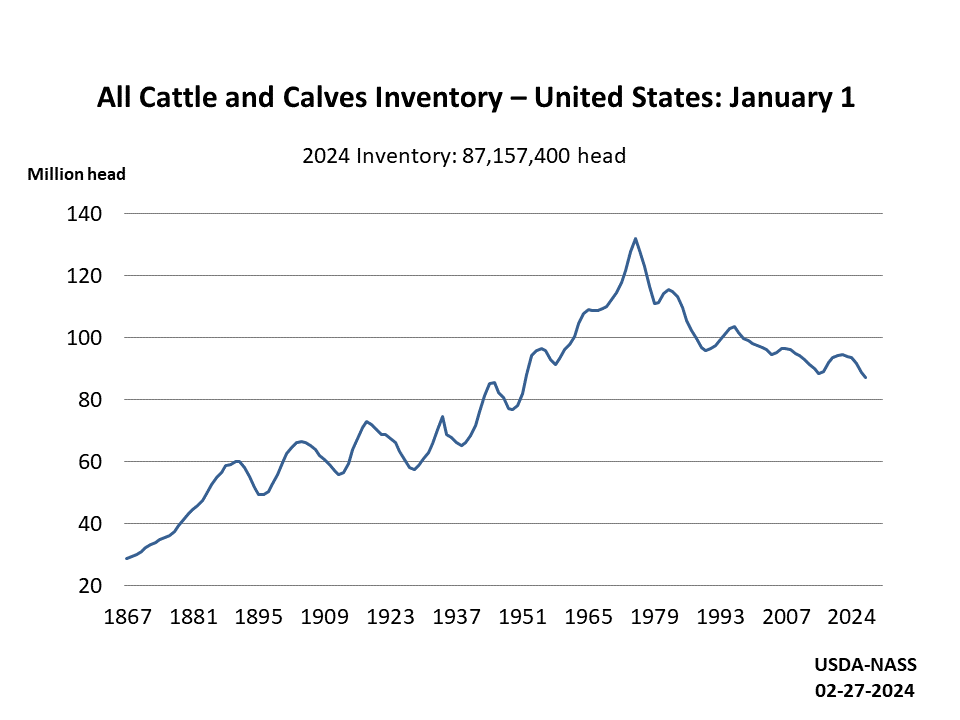
Cattle numbers in the U.S. are at their lowest in over 50 years. That is not because people are not trying it is because the model is broken.

A 90% calf crop is the breakeven point. Most international systems are nowhere close. If your herd is not averaging that or better, the genetics not the management might be the real issue.
Fertility Is Highly Heritable
The industry tells you fertility is lowly heritable. That is not true. It is just that most systems do not measure the right indicators.
A 2021 study out of Australia showed that real fertility traits like age at puberty AGECL and postpartum anestrus interval PPAI have heritability of 56% and 42%, respectively. That is highly heritable and highly overlooked.

Profit Per Acre > Profit Per Head
Rancher A.
50 Cows on 200 acres.
90% Calf Crop
45 calves to market
Average weight of 450 pounds.
20,250 pounds of live animals.
101.25 pounds per acre.
Rancher B.
40 Cows on 200 acres.
90% Calf Crop
36 calves to market
Average weight of 475 pounds.
17,100 pounds of live animals.
85.5 pounds per acre.
You do not get paid by the pound of potential. You get paid by the pound of beef you ship and how many acres it took to produce it. Rancher B’s calves weigh more. But Rancher A runs more cows per acre and weans more total pounds. That is the difference between selection for individual performance versus selection for system wide efficiency.
It is not about how big one calf is it is about how many pounds your land can produce.
How EPDs Don’t Tell The Whole Story

EPD’s of Profit Per Acre Bred Animal (Bull A)

EPD’s of Profit Per Head Bred Animal (Bull B)
Look at the difference. Animals bred for per-head profit often have high growth traits, high input requirements, and short productive lifespans. Animals bred for per-acre profit are more moderate, more fertile, and last longer.
But here’s the kicker: many EPD systems penalize balance. If a cow works well across the board, she often looks average on paper.We’re not interested in EPDs that punish function. We’re interested in cattle that breed back, stay sound, and make money in the real world.
Environment-Specific Selection
As seen in the EPDs above, these two bulls are not bred the same and they should not be expected to perform the same. Bull A is built for a grass based, low input system. Bull B was bred for high feed, rapid gain, and a different environment entirely. Both might be good but only one fits your operation. You cannot select cattle in one environment and expect them to thrive in another. Genetics are not one size fits all.
In a feedlot scenario, progeny from Bull B will outgain those from Bull A. But in a grass only environment, it is the opposite. Bull A’s offspring will outperform Bull B’s.
That is because cattle bred like Bull B have enormous daily requirements just to maintain condition. On pasture alone, they often struggle unless the rancher turns to heavy feed supplementation, which is rarely profitable and often not even feasible in many parts of the world.
Cattle bred like Bull A, however, are built for grass. They thrive in low input systems and maintain body condition without a feed truck. That ability to perform on forage is what allows them to stay in the herd longer, breed back consistently, and produce a calf every year.
EPDs also ignore a simple truth males and females are biologically different, and they will perform differently even when they share the exact same genetics.
Take a 15 month old bull and his 15 month old full sister out of fertile, function based bloodlines. Put them both into a performance test alongside generic cattle. That young bull might rank middle of the road on growth but his IMF score will likely suffer due to testosterone. Meanwhile, his sister may appear below average in frame and growth but she will show a much higher IMF value.
Same genetics. Two very different outcomes. That is not a flaw in the cattle it is a flaw in the model.

The Bos Sires Standard
This is not about ribbons. It is not about spreadsheet cattle, either. It is about real world performance on grass, under pressure, and without excuses.
We measure what matters fertility, adaptability, longevity, and pounds weaned per acre. That is what builds herds that last and operations that do not just survive but thrive.
If your goals line up with that maybe it is time we talked.